The Great Pacific Garbage Patch: Size, Location, and Latest Data

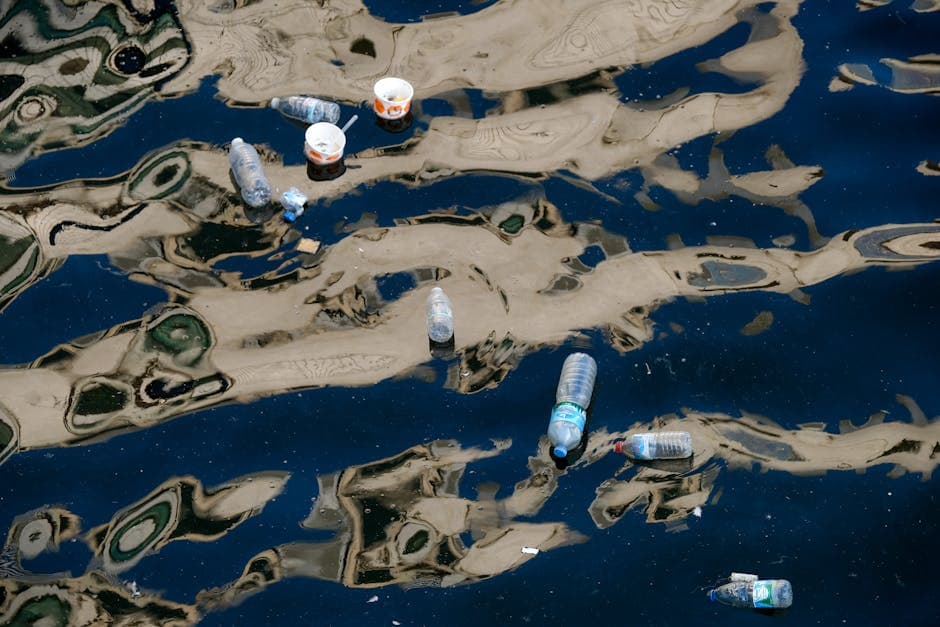
The Great Pacific Garbage Patch: Size, Location, and What the Data Actually Shows
The Great Pacific Garbage Patch (GPGP) is the largest accumulation of ocean plastic on Earth — a zone of concentrated marine debris spanning approximately 1.6 million square kilometres in the North Pacific Ocean. Contrary to how it's often described, the GPGP is not a solid floating island. It's a diffuse cloud of 1.8 trillion plastic fragments, most of them smaller than a grain of rice, suspended across the upper water column between Hawaii and California.
That disconnect between perception and reality matters. Because the longer the public imagines a visible, scoop-able island of trash, the longer we underestimate how difficult and urgent this problem really is.
Where Exactly Is the Great Pacific Garbage Patch?
The GPGP sits within the North Pacific Subtropical Gyre, a massive system of rotating ocean currents formed by four interacting currents: the North Pacific Current to the north, the California Current along the eastern edge, the North Equatorial Current to the south, and the Kuroshio Current on the west. Together they create a slow clockwise vortex that traps floating debris in a relatively stable zone.
The centre of the patch lies roughly between 135°W and 155°W longitude and 35°N and 42°N latitude — approximately halfway between Hawaii and California. That places it largely in international waters, outside any single country's jurisdiction. NOAA's Marine Debris Programme has mapped the gyre's boundaries through decades of surface trawl surveys, confirming that the debris concentration peaks in this zone and thins gradually toward the edges.
The gyre's geography also explains why cleanup is so logistically challenging. The patch occupies open ocean far from any port, and the debris is scattered across an area three times the size of France. There is no fixed shoreline to work from, no single dumping point to shut down.
How Big Is the Great Pacific Garbage Patch?
The most frequently cited measurement comes from a 2018 study published in Nature Scientific Reports by Laurent Lebreton and colleagues at The Ocean Cleanup. Using multi-vessel aerial surveys and surface trawls, the team estimated the GPGP covers 1.6 million km² — roughly twice the size of Texas, or three times the size of metropolitan France.
That same study produced the headline figure that has since become a benchmark for ocean plastic research: the patch contains an estimated 1.8 trillion pieces of plastic, with a combined mass of approximately 80,000 tonnes (some estimates extend to 100,000 tonnes). To put that in context, 1.8 trillion pieces means roughly 250 pieces of plastic for every human being on the planet, concentrated in a single ocean zone.
The GPGP's size is not static. Analysis by the 5 Gyres Institute indicates that the concentration of floating plastic in the open ocean has been accelerating since roughly 2005, with microplastic counts increasing at a rate that outpaces what accumulation models predicted based on production data alone. Their 2023 study estimated the total number of floating plastic particles across all oceans at 82–358 trillion — meaning the GPGP, while the largest single accumulation, is only one component of a global problem. For more on total ocean plastic figures, see our breakdown of how much plastic is in the ocean.
What Does the Great Pacific Garbage Patch Look Like?
Here is what the GPGP is not: it is not visible from space, it is not a floating landfill, and you cannot walk across it. That image — a solid, garbage-island-in-the-Pacific — is one of the most persistent misconceptions in environmental communication.
The reality is less photogenic and more alarming. The vast majority of the GPGP consists of microplastics: fragments smaller than 5 mm that have degraded from larger objects through UV exposure and mechanical weathering. These particles are suspended throughout the water column, from the surface down to several metres depth, creating a kind of plastic soup that is often invisible to the naked eye. A ship sailing through the centre of the patch might see scattered larger debris — bottle caps, crates, fishing floats — but the water would not look obviously polluted.
What you would notice, if you dragged a fine-mesh trawl net through the surface, is that it comes up full of confetti-sized plastic shards in every colour. That is the signature of the GPGP: not a visible mass but a measurable concentration.
This matters for public understanding because the "garbage island" myth has created unrealistic expectations about cleanup. You cannot simply skim a solid surface. Every approach to removal must contend with billions of tiny particles dispersed across millions of square kilometres of open water.
What Is the Great Pacific Garbage Patch Made Of?
The Lebreton et al. study provided the most detailed composition analysis to date. The findings reframed the conversation about ocean plastic.
Fishing gear dominates. An estimated 46% of the GPGP's total mass is abandoned fishing nets, often called ghost nets. These are heavy, durable, made of synthetic polymers (nylon, polyethylene, polypropylene), and they continue to trap and kill marine life long after they're lost or discarded — a phenomenon known as ghost fishing.
The remaining mass consists of: